
Pipe Bursting is one of the most cost-effective, long-lasting ways to replace a failing sewer line without tearing up your yard. At $115 per linear foot with a 50-year warranty, it’s the trenchless method we at Father & Son Hydro-Jetting recommend most — and it’s the one we’d choose if it were our own home.
If your sewer line is cracked, collapsed, or has been invaded by roots, you’ve probably heard two main options: lining or trenching. But there’s a third path that most homeowners don’t know enough about, and it often wins on both performance and price.
Here’s what Pipe Bursting actually is, how it works, and why it’s become our go-to recommendation for homeowners across the San Fernando, Santa Clarita, Conejo and Simi Valleys.
What Is Pipe Bursting?
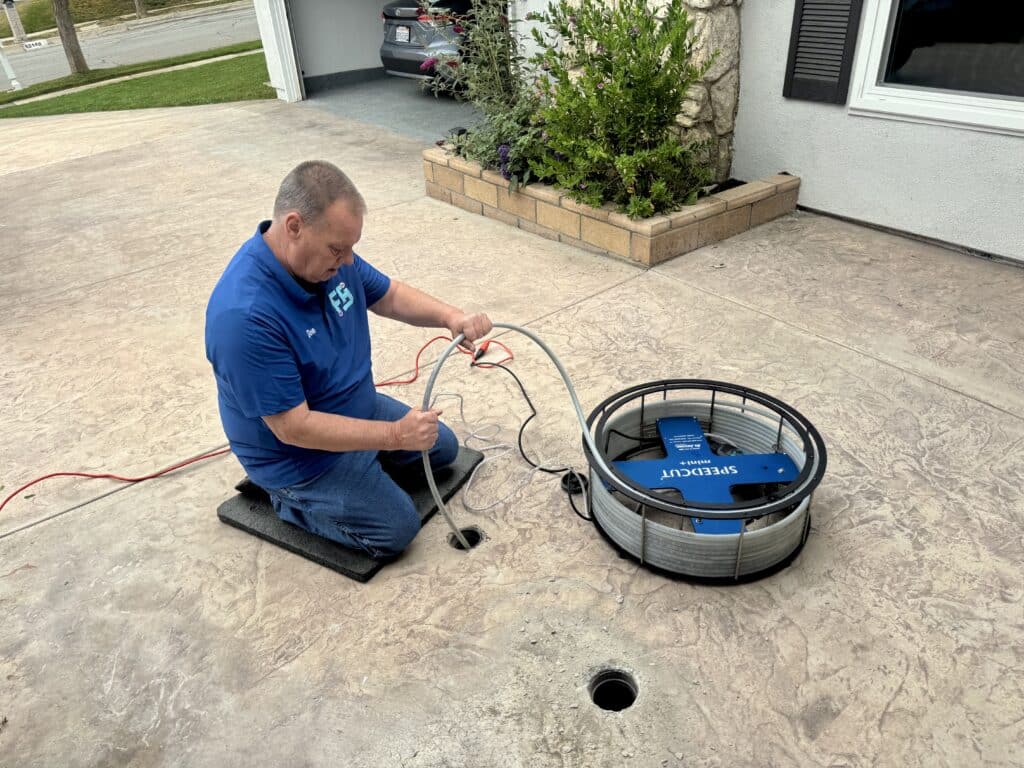
Pipe Bursting is a trenchless sewer replacement method. Instead of digging a long trench to remove your old pipe, a technician creates access points — typically just two holes — and pulls a new pipe through the existing line. As the new pipe moves through, a bursting head fractures and displaces the old pipe outward into the surrounding soil.
The result? A brand-new, solid pipe in place of the old one — with no major excavation required.
Pro Tip: Pipe Bursting requires one access hole at each end of the run, plus one hole for every change in direction. Most residential jobs need just two to four holes total, keeping your yard and landscaping largely intact.
How Pipe Bursting Differs from Traditional Pipe Joints
This is where Pipe Bursting really separates itself from standard ABS pipe replacement.
With traditional ABS pipe installation, you get a series of sections joined together with fittings at every connection point. Those joints are potential weak spots — places where tree roots can probe, where shifting soil can create stress, and where buildup can accumulate over time if not correctly installed with CODE approved couplings.
Pipe Bursting installs a continuous, seamless pipe. There are no joints along the straight runs — just solid, uninterrupted pipe from one access point to the next. The only connection points are at changes in direction, and those are handled cleanly during installation.
Think of it like the difference between a segmented garden hose with connectors every few feet versus a single, unbroken hose. The fewer seams, the fewer opportunities for failure.
Why We’d Choose Pipe Bursting for Our Own Home
When a client asks us what we’d do if this were our house, the answer is usually Pipe Bursting — and here’s why.
It handles ground movement well. Los Angeles homes sit on soil that shifts, especially hillside properties and homes near fault lines. The continuous pipe used in Pipe Bursting is far more forgiving of minor ground movement than a line full of joints. With sewer line rehabilitation options like CIPP lining, you get a solid liner inside the existing pipe — but Pipe Bursting replaces the pipe entirely with new material that starts fresh.
It comes with a 50-year warranty. That’s the same warranty as our CIPP liner. The difference is that with Pipe Bursting, you’re getting a completely new pipe, not a rehabilitated version of an old one. For homeowners who plan to stay in their house long-term — or who want to maximize resale value — that distinction matters.
It’s more cost-effective than lining in many situations. People assume lining is always cheaper because it sounds less invasive. That’s not always true. Pipe Bursting at $115 per linear foot is often the more economical choice, particularly when the existing pipe is too deteriorated to host a liner effectively.
Did You Know: A sewer camera inspection is the first step before any Pipe Bursting job. The inspection tells us the length of the pipe and the depth of access points needed — which is all we need to give you an accurate estimate. Learn more about what a sewer line inspection involves before committing to any repair.
What the Pipe Bursting Process Looks Like
We’ve done hundreds of these jobs, and the process is more straightforward than most homeowners expect.
First, we run a sewer camera inspection to confirm the pipe’s condition, map its path, and measure the run. We need to know two things: the length of the pipe and the depth at each access point. That’s it.
From there, our crew identifies the entry and exit points. We dig access holes — one at each end of the affected run, plus one for every bend or change in direction. In most residential jobs, that’s two to four holes.
A steel cable is threaded through the old pipe. Attached to the cable is a cone-shaped bursting head, slightly larger than the old pipe’s diameter, followed by the new pipe. As the equipment pulls the cable, the bursting head fractures the old pipe and the new one slides into place behind it.
Most jobs are completed in a day or two. Your sewer is back in service quickly, and your yard looks far better than it would after a traditional dig-and-replace job.
Pro Tip: Before scheduling any sewer work, check whether your property has a proper cleanout installed. If it doesn’t, that’s a quick add-on that makes every future inspection and service call easier. Ask our team about cleanout installation when you book.
Pipe Bursting vs. Sewer Lining: Which Is Right for You?
Both are trenchless. Both carry a 50-year warranty through our work. So how do you choose?
Sewer lining (CIPP) works by inserting a resin-saturated liner into the existing pipe and curing it in place. It’s a great option when the existing pipe still has structural integrity — when the pipe is cracked or corroded but not collapsed or severely offset.
Pipe Bursting is the better call when the existing pipe is too far gone to support a liner, when you want a completely new pipe rather than a rehabilitated one, or when cost is a deciding factor. According to the National Association of Sewer Service Companies (NASSCO), trenchless methods like Pipe Bursting have become the industry standard for residential sewer replacement precisely because they minimize property disruption while delivering durable, long-term results.
Here’s a quick comparison:
| Factor | Pipe Bursting | CIPP Lining |
| New pipe or rehabilitated? | New pipe | Rehabilitated existing pipe |
| Joints in straight runs | None | None |
| Warranty | 50 years | 50 years |
| Best for | Deteriorated or collapsed pipe | Structurally sound but damaged pipe |
| Cost | $115/linear foot | $185/linear foot |
What Affects the Cost of Pipe Bursting?
Pricing is simpler than most people expect. At Father & Son, Pipe Bursting runs $115 per linear foot. The two factors that determine your total cost are:
The length of the pipe being replaced, and the depth of the access holes. Deeper access points require more labor and equipment, so a line running 8 feet underground costs more to access than one at 3 feet.
That’s why the sewer inspection comes first. Once we know the footage and the depth, we can give you a real number — not a guess. According to HomeAdvisor’s national cost data, trenchless sewer replacement typically runs between $80 and $250 per foot depending on region and conditions. Our flat $115/foot rate keeps things predictable and competitive for the LA area.
Did You Know: Most homeowners insurance policies do not cover sewer line replacement. That makes cost predictability even more important — which is why we give you an inspection-backed estimate before any work begins.
To Wrap Up
Pipe Bursting isn’t the flashiest sewer repair method, but it might be the smartest. It gives you a solid, seamless pipe with no mid-run joints, a 50-year warranty, and a straightforward cost structure — all without turning your yard into a construction site.
If you’re dealing with a failing sewer line and want to know whether Pipe Bursting makes sense for your property, the first step is a camera inspection. Call Father & Son Hydrojetting at (818) 900-7493 or request a free estimate online — we’ll tell you exactly what you’re working with and what it’ll cost to fix it right.
Frequently Asked Questions
How long does Pipe Bursting take? Most residential Pipe Bursting jobs are completed in a day or two. Once we have the inspection data and access holes are excavated, the actual pipe replacement process is fast — typically a few hours for a standard residential run.
Does Pipe Bursting work on all types of pipe? Pipe Bursting works on most common sewer pipe materials, including clay, orangeburg, and older PVC. The key requirement is that there’s enough soil space around the pipe for the burst material to displace. A camera inspection confirms whether your pipe is a good candidate.
How many holes does Pipe Bursting require? Pipe Bursting requires a minimum of two access holes — one at each end of the run — plus one additional hole for every change in direction. Most residential jobs need two to four holes total, which is far less disruptive than traditional open-trench replacement.
Is Pipe Bursting covered by homeowners insurance? Most standard homeowners insurance policies do not cover sewer line repair or replacement unless you’ve added a specific sewer line rider. We recommend checking your policy before scheduling work and asking your insurer about sewer line coverage options.
How is Pipe Bursting priced? Pipe Bursting at Father & Son is priced at $115 per linear foot. The total cost depends on the length of pipe being replaced and the depth of the access points. A sewer camera inspection gives us everything we need to provide an accurate, no-surprise estimate.